


You wake up tired. So you reach for caffeine.
You rush through the morning, answer messages before you’ve fully woken up, sit for hours, skip breaks, push through stress, and keep going because life feels busy and demanding.
By the evening, you finally STOP… but your mind doesn’t.
You feel exhausted, yet somehow still wide awake. Sound familiar?
If so, you’re certainly not alone.
As someone who has spent over 22 years working in health, fitness and workplace wellbeing, I honestly believe many of us are not simply struggling with sleep… we are struggling with recovery. At Tonic, we often say:
“We don’t just have a stress crisis — we have a recovery crisis.”
And the more I work with individuals, leaders, and organisations, the more I believe this to be true.
Because sleep problems do not always start at bedtime. Sometimes they start the moment we wake up.
7am — Alarm Mode
For many people, the day begins in a state of activation.
- Alarm clocks
- Notifications
- Emails
- Rushing
- Pressure
- Mental lists already forming before our feet even touch the floor
Our body’s natural “wake-up” response is designed to help us feel alert and ready for the day. But modern life often takes that normal alertness and pushes it straight into overstimulation. Many of us spend the entire day in “go mode” without ever fully slowing down.
Mid-Morning – Stimulation Without Recovery
- We sit for long periods.
- We multitask.
- We move less.
- We absorb constant information and stimulation.
Coffee replaces pauses.
Screens replace daylight.
Pressure replaces presence.
Humans were designed for cycles of effort and recovery — not constant output.
Movement matters here more than people often realise.
Not just intense exercise or gym sessions, but regular movement throughout the day:
Walking… Stretching… Changing posture… Getting outside… Breathing properly… Giving the nervous system signals of safety and release.
Ironically, sedentary lifestyles can leave us feeling more fatigued, not less.
Afternoon – The Build-Up We Ignore
This is where stress often accumulates quietly.
- Mental fatigue.
- Decision overload.
- Emotional labour.
- Tension in the shoulders and jaw.
- Reduced patience.
- Brain fog.
- Low energy.
And because many of us are high-functioning and capable, we often ignore the signals.
We normalise survival mode.
We tell ourselves we are “just busy.”
But the body keeps score of the entire day.
Evening – Exhausted But Still Switched On
This is the part I hear people describe all the time. “I’m shattered… but I can’t switch off.” And it makes complete sense. Because sometimes exhaustion does not feel like collapse. Sometimes it feels like restlessness.
We scroll… Watch another episode… Snack mindlessly… Stay awake later than intended because we finally have a moment to ourselves.
Our body is tired. But our nervous system is still activated. Many people think sleep is simply about what happens at night. But quality sleep is influenced by what happens all day long.
Sleep Is a Whole-Day Process
Better sleep is not only built through bedtime routines.
It is shaped by:
- how we manage stress
- how much we move
- whether we pause
- our exposure to daylight
- our boundaries
- our recovery habits
- our emotional load
- our nervous system state
This is why recovery matters so much.
Recovery is not laziness.
It is not weakness.
And it is certainly not wasted time.
Recovery is maintenance for the human body and brain.
Without it, we may continue functioning for a while… but eventually something starts to suffer:
- our patience,
- our energy,
- our focus,
- our mood,
- our resilience,
- or our health.
A Simple Tonic Recovery Check-In
Before burnout or exhaustion fully hits, the body often whispers first.
The challenge is that many of us have become so used to functioning under pressure that we stop noticing the signals.
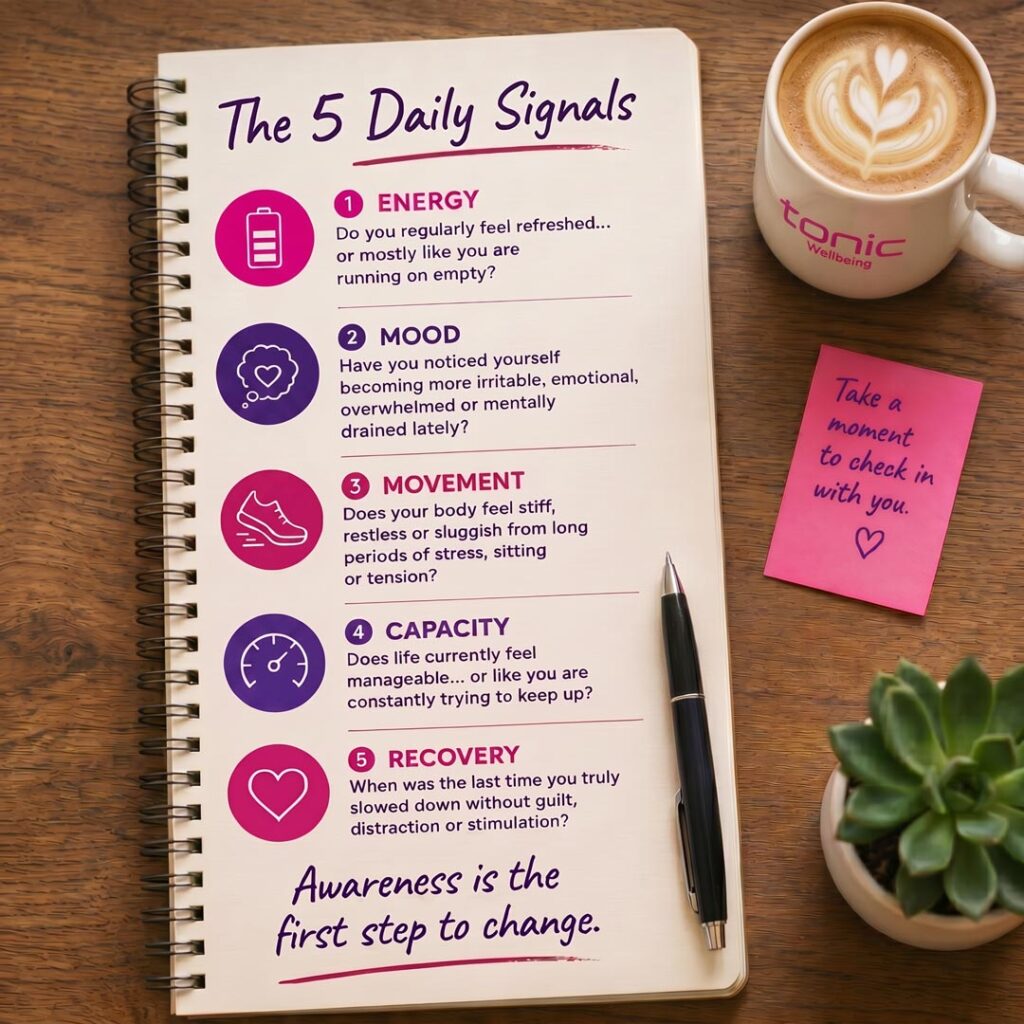
Take a quiet moment to reflect:
1. ENERGY – Do you regularly feel refreshed… or mostly like you are running on empty?
2. MOOD – Have you noticed yourself becoming more irritable, emotional, overwhelmed or mentally drained lately?
3. MOVEMENT – Does your body feel stiff, restless or sluggish from long periods of stress, sitting or tension?
4. CAPACITY – Does life currently feel manageable… or like you are constantly trying to keep up?
5. RECOVERY – When was the last time you truly slowed down without guilt, distraction or stimulation?
The Goal Isn’t to Push Harder…
Modern life often celebrates coping at all costs. Wearing a badge of busyness and getting rewarded? But functioning in survival mode is not sustainable wellbeing. Sometimes the strongest thing we can do is recognise the signals earlier.
To pause.
To recover.
To move.
To breathe.
To sleep.
Because better wellbeing does not always start with doing more. Maybe it starts with recovering better.
At Tonic Wellbeing, we help individuals and organisations move from simply coping to creating healthier, more sustainable ways of working and living. Through our workshops, wellbeing programmes, health insights and practical tools, we help people understand their own signals, build healthier habits, and take action before wellbeing starts to suffer. Because awareness is the first step to change.
To find out more about Tonic Wellbeing workshops and support available for your people, visit: www.choosetonic.co.uk.


